

Healthcare Brand Establishes Clear Rules for EmpCo-Compliant Sustainability Communications
Sustainable Claims Audit for a Manufacturer of Healthcare and Personal Care Products
Challenge / Approach
For years, the manufacturer of healthcare and personal care products had been communicating its sustainability efforts through various channels. However, with the introduction of EU Directive 2024/825 (the Empowering Consumers Directive, or EmpCo), the requirements have become more stringent. In future, sustainability claims must be specific, substantiated and complete.
For the company, this consequently became an issue requiring careful review, with both legal and reputational risks.
The central question was: How can an extensive portfolio of websites, social media content, and other formats be systematically reviewed for compliance with the new directive? How can internal teams and external content partners work independently according to a consistent standard in future?
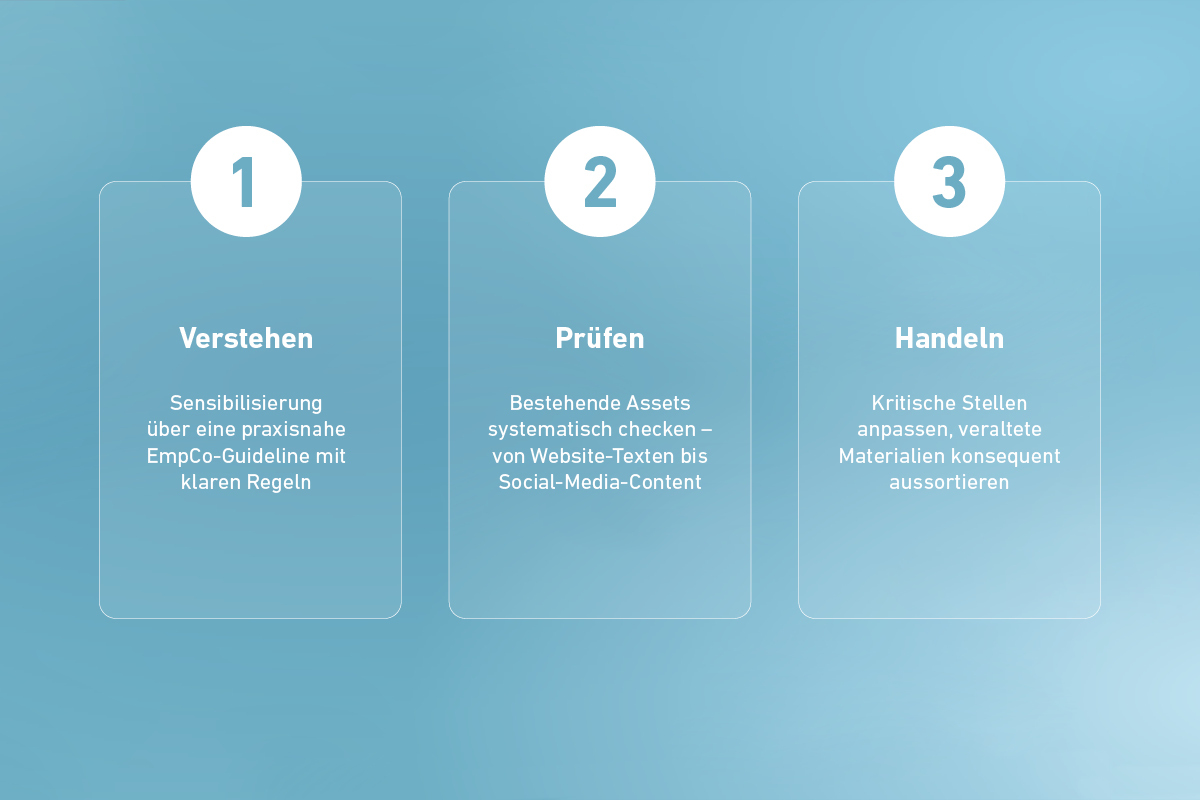
To address these issues, Klenk & Hoursch combined regulatory and communications expertise. The guiding principle was 'understand, review, act'.
Instead of assessing individual claims in isolation, the aim was to establish a reliable decision-making framework that prioritises risks and can be applied to day-to-day communications.
Umsetzung
Klenk & Hoursch implemented the project using three interconnected components.
1. Understand: Developing an EmpCo guideline
A practical guideline translated the requirements of the EmpCo into concrete rules for the communications team. It explained verification and disclosure obligations, categorised sustainability labels, and set out the legal requirements to consider when creating and reviewing content. This fostered a shared understanding of which claims needed substantiating and which formulations required particular caution.
2. Review: Analysing social media assets
Klenk & Hoursch reviewed social media assets from the second quarter of 2026, including videos, images, texts and voice-overs. The analysis also considered grandfathering provisions and developed a risk-based review approach for future content. The resulting optimisation recommendations can be incorporated directly into the asset creation process.
3. Act: Evaluating website claims at scale
Klenk & Hoursch developed a dedicated tracker for the website that systematically reviewed a large number of URLs for sustainability claims. The relevant passages were categorised in context and grouped according to risk categories.
An AI-supported assistant then mapped these claims against the EmpCo text, the German Act Against Unfair Competition (UWG), and relevant case law. Each classification was explained transparently and comprehensibly.
AI increased the speed and completeness of the analysis. However, the final assessment and prioritisation were carried out jointly by the consultants and the company’s communications team.